
Browser Games
Best Fishing Games for You to Try Out!

 Do you love fishing and you’re upset whenever you don’t have enough time to relax with the fishing rod in your hand, or when the weather’s awful or you simply can’t go? Don’t be anymore as there are a lot of fishing games online that can help you relax and enjoy a fishing trip without any (major) costs. Read on to learn how and where to find the best online fishing games over the internet and never be upset again if you can’t fish in the real world!
FREE fishing games to play online
As you can imagine, there are a ton of awesome fishing games you can play online in your browser without any additional download and without paying a cent (or penny, or whatever is your currency!). Check out some of the best free fishing games below:
– Reel Fishing (could also be considered “Real fishing,” a really natural and great fishing sim! Click the link to play it!)
– Fishing Champion (a very detailed simulation of fishing, another must play – click here to do so)
– Lake Fishing 2 (great visuals, not an amazing fishing experience though – click the link to play it!)
– 13 free online fishing games including Fish Hunter 2, Fishing Champion, Weekend Fishing, Super Fishing and Japanese Fishing. All of them available over at OnlineFishingGames.
Offline Fishing Games
So, you want even more challenge and a fishing experience that’s as close to the real thing as possible? Then you could try out some offline fishing games – these are not free to play, but most of them offer demos to check them out and generally they are worth every penny. Great offline fishing games are:
– FlySim is a truly realistic fishing game you can get a free demo for. It has tons of features and will certainly turn you into a pro fisherman (or woman) if you’re not one already. Check out the official page of the game for more details and at least download the demo to check this great offline fishing game out!
– other games for you to search for are: Rapala Pro Fishing, Pro Bass Fishing and In-Line Fishing. These games were released quite a while ago and I can’t understand why game developers don’t create any more fishing games… but hey! We should use what we have and enjoy them because there are quite a few cool fishing games here – both free and purchasable!
Which is your favorite fishing simulation computer game?




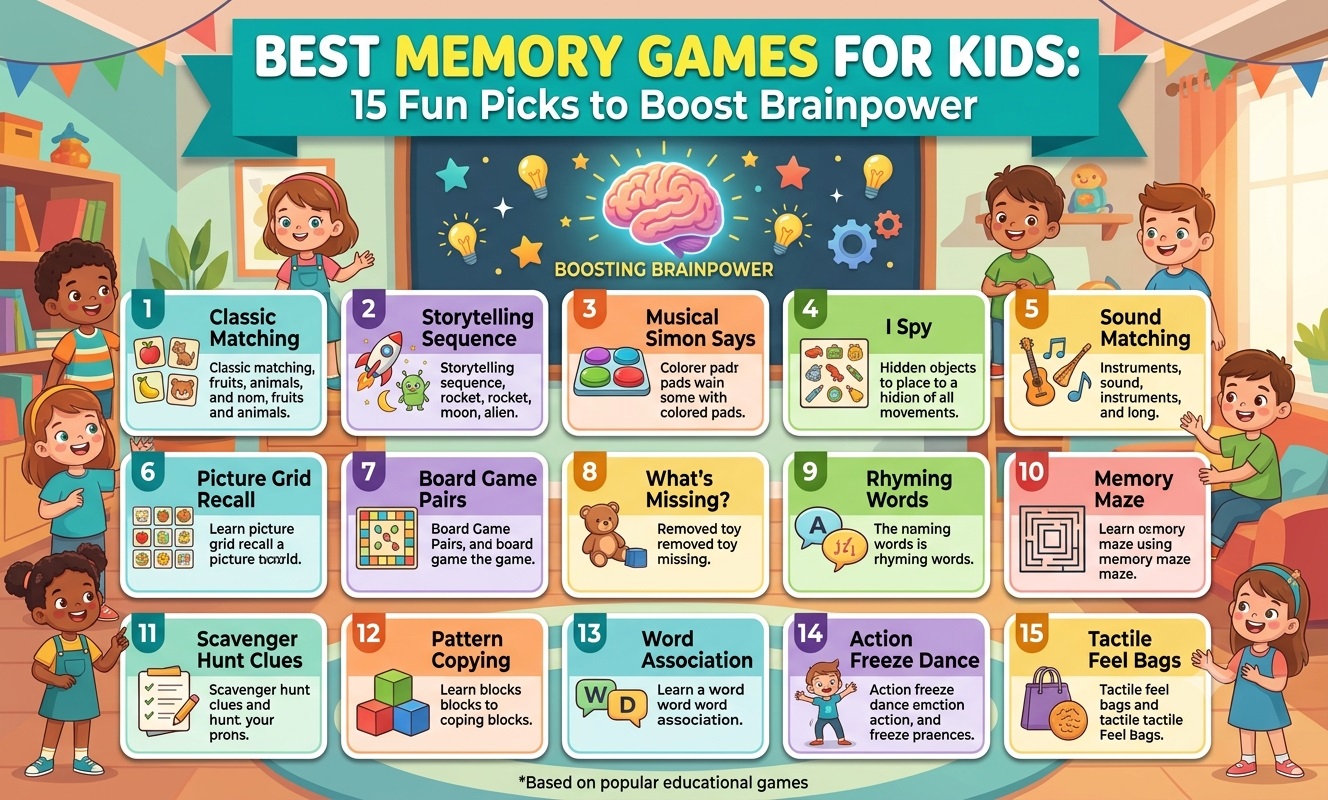
The best memory games for kids include classic Concentration card games, Spot It!, Simon, and Melissa & Doug matching sets, each chosen to match a child’s age and attention span. These games build working memory, focus, and pattern recognition while keeping playtime fun rather than feeling like schoolwork. Below is a breakdown by age group, plus 15 tried-and-tested picks parents and teachers reach for again and again.
Why Memory Games Matter for Kids
Memory games do more than pass the time on a rainy afternoon. When a child flips two cards looking for a match, or repeats a sequence of taps back to a toy, they’re exercising working memory, the mental scratchpad the brain uses to hold and manipulate information for a few seconds at a time. That skill underpins everything from following multi-step instructions to solving math problems and reading comprehension.
These games also sharpen focus and pattern recognition. A child learns to notice small differences between cards, track where things are located, and predict what comes next in a sequence. Over time, this kind of practice supports better attention spans, both during play and in the classroom.
There’s also a case for tactile, screen-free play. Physical memory games, cards, tiles, and board pieces, engage fine motor skills and encourage face-to-face interaction, which digital versions can’t fully replicate. That doesn’t mean apps are off the table; a mix of both, weighted toward hands-on play for younger kids, tends to work best.
How to Choose a Memory Game by Age
Toddlers (Ages 2-4)
At this age, simplicity wins. Look for games with large, chunky pieces that are easy to grip and hard to accidentally swallow. A small deck of eight to ten matching pairs, featuring animals or familiar objects, is plenty of challenge. Sessions should be short, five to ten minutes, since attention spans are still developing.
Young Kids (Ages 5-7)
This is the sweet spot for classic Concentration-style card games. Kids at this stage can handle 12 to 20 pairs, follow simple turn-taking rules, and enjoy a bit of friendly competition. Sequence-based games like Simon also start to click around age five or six, since kids can now hold a growing string of steps in mind.
Older Kids (Ages 8-12)
Older children are ready for games that combine memory with strategy, speed, or social deduction. Think Spot It!, Bop It!, or elimination games like Guess Who?, where recall has to work alongside quick thinking. This age group also benefits from games that introduce mild time pressure, since it builds recall speed without becoming stressful.
15 Best Memory Games for Kids
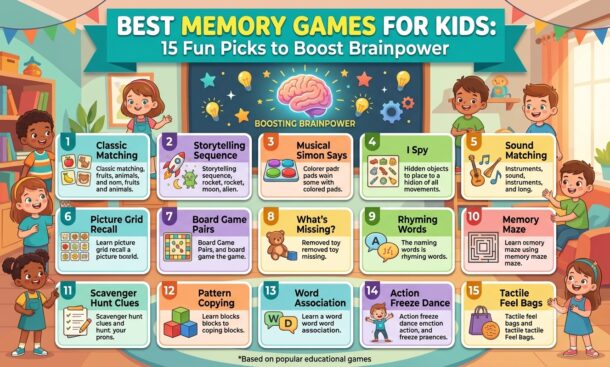
1. Classic Memory / Concentration Cards
This is the game most people picture the second they hear “memory game,” and it earns its reputation. Cards are laid face-down in a grid, and players take turns flipping two at a time, trying to find a matching pair while quietly logging everyone else’s flips in their head. What makes it such a durable pick is how easily it scales: eight pairs of farm animals is plenty for a three-year-old, while a determined ten-year-old can handle a 30-card spread without blinking. It’s also one of the few games where losing still teaches something, since a wrong flip hands a free clue to the whole table, and kids quickly learn to actually watch other players’ turns instead of tuning out. Themed decks (dinosaurs, flags, multiplication facts) let you sneak in extra learning without it feeling like a lesson.
2. Spot It! (Dobble)
Spot It! trades the slow, deliberate pace of Concentration for something much faster: every card in the deck shares exactly one matching symbol with every other card, and players race to spot it first. That single design trick turns the game into a genuine reflex-and-recall workout, since kids aren’t just remembering where things are, they’re scanning, comparing, and naming under mild time pressure. There are several mini-game modes packed into one box, so the pace and difficulty can shift depending on the age mix at the table, which makes it one of the rare games that works for a wide sibling age gap. Rounds run 60 seconds or less, which is ideal for keeping a fidgety six-year-old engaged without demanding a long attention span.
3. Simon (Electronic)
Simon is the classic light-and-sound sequence game: the device flashes a pattern of colored buttons, and the player has to press them back in the same order, with the sequence growing by one step every round. It’s a clean, almost clinical way to watch working memory stretch in real time, since there’s no strategy or luck involved, just how many steps a child can hold in mind before the chain breaks. Because the device does the sequencing and scorekeeping, it works well as solo practice too, letting a child quietly try to beat their own best round without needing a second player. Newer digital and app versions add difficulty modes and multiplayer options, but the original button-and-beep format still holds up as a no-frills memory drill.
4. Perfection
Perfection hands players a tray of oddly shaped holes and a pile of matching pieces, then starts a loud, ticking timer that pops the whole board if the tray isn’t filled in time. The memory challenge is subtler than it looks: after a round or two, kids start remembering roughly where each shape goes instead of hunting from scratch, which is exactly the kind of spatial recall the game is designed to build. The ticking timer adds just enough urgency to sharpen focus without tipping into real stress for most kids, though very anxiety-prone children may prefer playing with the timer removed. It also doubles nicely as a fine-motor exercise, since fitting oddly angled pieces into tight slots takes a steady hand as well as a sharp memory.
5. Melissa & Doug Memory Match Games
These matching sets are built specifically with toddlers and preschoolers in mind, using thick, chunky cards with bright, simple illustrations that are easy for small hands to hold and easy for developing eyes to tell apart. The pair counts stay deliberately low, often 12 pairs or fewer, so a first-time player isn’t overwhelmed before they’ve even learned the rules. Because the sets are sturdy and easy to wipe down, they hold up well to the inevitable chewing, dropping, and juice-spilling that comes with this age group. They’re also a natural bridge into vocabulary building, since many sets pair a picture with its written word, letting parents fold in early reading practice alongside the matching game.
Top 6 Indoor Games You Can Play During Coronavirus Quarantine
6. Rory’s Story Cubes
Story Cubes look like a simple dice game at first glance, nine dice, each face a different icon, but the memory workout comes from what happens after the roll. Kids build a story that links every image together in order, which means holding onto a growing chain of plot points while inventing what comes next, then trying to retell the whole thing coherently at the end. It’s a looser, more creative form of sequential memory practice than most games on this list, and it rewards imagination as much as recall, so kids who find flashcard-style games boring often take to this one instead. Playing in a group adds a layer of listening memory too, since each player has to track the story so far before adding their own piece.
7. Simon Says
No board, no cards, no batteries, just a leader calling out instructions and a group of kids trying to follow only the ones prefaced with “Simon says.” The memory demand is sneaky: players have to hold the rule in mind (only move on the magic phrase) while their brain is simultaneously racing to process and react to a fast stream of commands. That combination of rule-memory and impulse control is genuinely tricky for young kids, which is exactly why it’s such a good early exercise, most five- and six-year-olds get caught out at least once before they settle into the rhythm. It travels anywhere, costs nothing, and works for groups of any size, making it a reliable backup whenever a rainy classroom or a long car-park wait needs filling.
8. Kim’s Game
Kim’s Game is about as low-tech as memory games get: place a dozen or so household objects on a tray, let kids study the arrangement for a minute, then cover the tray and ask them to list everything they can remember, or remove one item and ask what’s missing. It’s a favorite among teachers and Scout leaders precisely because it needs no equipment beyond whatever is lying around the house, a spoon, a toy car, a hairbrush, a coin. Difficulty is easy to dial up or down just by changing how many objects are on the tray or how similar they look to each other, which makes it one of the few games that genuinely works for a three-year-old and a twelve-year-old in the same afternoon. It’s also a great diagnostic for parents curious how a child’s recall compares across different types of objects, shapes, colors, or textures.
9. Memory Maze Apps
For families that are comfortable with a bit of supervised screen time, spatial memory apps show a child a path through a maze for a few seconds, hide it, and then ask them to retrace the route from memory, with mazes growing larger and more twisted as they succeed. The format is good at isolating spatial working memory specifically, which is a slightly different muscle than the visual matching most card games target, and the instant feedback loop keeps kids motivated to try just one more round. The caveat is that these apps work best as a short, focused add-on rather than a main event, ten minutes of maze recall paired with plenty of physical, hands-on play tends to serve a child better than long unsupervised app sessions. Parents should check age ratings and ad content before downloading, since not all “educational” memory apps are actually built with kids’ attention spans in mind.
3 Most Addictive MultiPlayer Games to Play
10. Uno
Uno is usually filed under “color matching game,” but there’s a real memory layer running underneath the surface. Sharp players start tracking which numbers and colors have already been played, which cards are statistically more likely to still be in the deck, and which opponents are likely holding a Draw Four or a Skip based on how they’ve been playing. That kind of card-counting-lite is a natural, almost invisible way to build working memory in kids who’d roll their eyes at a flashcard drill. It’s also endlessly replayable, cheap, portable, and flexible enough in player count that it works for a family game night or a two-person wait at the doctor’s office.
11. Dominoes
Dominoes asks players to match numbers or dot patterns across a growing, branching line of tiles, and the memory demand increases every time a new tile goes down. In a game with more than two players, keeping track of which numbers have already appeared, and therefore which ones are running low, becomes its own quiet memory exercise, on top of simply remembering what’s in your own hand. Longer games with multiple branching ends add a layer of forward planning, since a move that looks safe now can box a player in two turns later if they haven’t been tracking the board. It’s a genuinely multi-generational game too, simple enough for a six-year-old to grasp the basic matching rule, with enough strategic depth for adults to still find it engaging.
12. Bop It!
Bop It! fires off a rapid stream of audio commands, twist it, pull it, bop it, flick it, and players have to react correctly and instantly or the game ends the round. Unlike most games on this list, the memory challenge here is almost entirely auditory: kids have to process a spoken instruction, retrieve the correct physical action from memory, and execute it within a second or two, all while the commands get faster and more randomized. That combination makes it a great fit for slightly older, more energetic kids who’ve outgrown the pace of matching card games but still benefit from short, sharp recall practice. It’s also a good solo option, since the device tracks its own high scores, letting a child compete against their own best run without needing a second player in the room.
13. Guess Who?
Guess Who? is built around a simple back-and-forth of yes-or-no questions, but winning depends on remembering exactly which traits have already been ruled out on the board, hair color, glasses, hats, so a player doesn’t waste a turn re-asking something they already know. That’s a gentle, low-stakes introduction to deductive memory, holding a growing list of eliminated possibilities in mind while narrowing in on an answer, which is a slightly different skill than the pure visual recall most memory games focus on. Younger kids often need a round or two of gentle coaching before they stop repeating questions, but most pick up the logic quickly once they see how much faster it goes when they actually track their own progress. It’s also a solid two-player option for car rides or waiting rooms, since it needs a flat surface but nothing else.
Most Popular Free Games in the US
14. DIY Printable Memory Cards
Homemade memory cards cost nothing beyond a bit of printer ink and index cards, and they let a parent tailor the game entirely to whatever a child is currently obsessed with, dinosaurs, planets, a favorite cartoon, even photos of family members for very young kids still learning names. Because the theme is chosen by the parent, it’s easy to sneak in an educational angle, letter-sound pairs for a child learning to read, multiplication facts for an older one, without it feeling like an assignment. Laminating the cards, or slipping them into cheap plastic sleeves, turns a one-off craft project into a durable game that survives sticky fingers and repeated play. It’s also a good low-cost way to test whether a child actually enjoys memory-style games before spending money on a store-bought set.
15. Brain Box Games
Brain Box games hand a player a card with a busy, detailed illustration, give them ten seconds to study it, then flip the card and ask a quiz question about something specific in the image, how many apples were on the table, what color was the door. That format targets a slightly different skill than most games on this list: rapid encoding of detail under a hard time limit, rather than matching or sequencing. Topic-specific decks (space, animals, world geography) mean the game doubles as light trivia practice, which makes it a popular pick for classrooms and long car trips alike. Because each round is short and self-contained, it’s easy to dip in and out of without needing to set aside a big block of time.
Comparison Table
| Game | Age Range | Players | Typical Price | Key Skill Developed |
| Classic Memory / Concentration Cards | 3-8 | 2-4 | $ | Visual recall, focus |
| Spot It! (Dobble) | 6+ | 2-8 | $ | Visual scanning speed, pattern recognition |
| Simon (Electronic) | 6+ | 1-4 | $$ | Sequential memory, auditory-visual recall |
| Perfection | 5+ | 1+ | $$ | Working memory, speed under pressure |
| Melissa & Doug Memory Match | 3-6 | 2-4 | $ | Early matching, vocabulary |
| Rory’s Story Cubes | 6+ | 1-6 | $ | Sequential/narrative memory, creativity |
| Simon Says (no-prop game) | 4+ | 2+ | Free | Listening memory, impulse control |
| Kim’s Game (tray game) | 5+ | 1+ | Free/DIY | Short-term visual recall |
| Memory Maze apps (age-gated) | 7+ | 1 | Free-$ | Spatial memory, planning |
| Uno / card-sequence games | 7+ | 2-6 | $ | Working memory, strategy |
| Dominoes | 6+ | 2-4 | $ | Pattern memory, sequencing |
| Bop It! | 8+ | 1+ | $$ | Reaction memory, auditory processing |
| Guess Who? | 6+ | 2 | $ | Elimination memory, deductive recall |
| DIY Printable Memory Cards | 3-10 | 1-4 | Free | Customizable recall practice |
| Brain Box quiz-and-recall games | 8+ | 1-4 | $$ | Detail retention under time pressure |
Did You Know?
Working memory capacity in children roughly doubles between the ages of four and fourteen, growing from the ability to hold about two to three pieces of information at once to five or more. Simple games that stretch this capacity a little at a time, rather than overwhelming it, are one of the most effective ways to build it up naturally through play.
Tips to Make Memory Games More Effective
A few small habits make a big difference in how much kids get out of memory games. Keep sessions short and end on a win, five to fifteen minutes is usually enough before attention starts to fade, and finishing on a successful round keeps kids wanting to come back. Repetition matters more than variety at first; playing the same game several times in a week builds more skill than switching games constantly. Positive reinforcement should focus on effort and strategy rather than just winning, praising a good guess or a smart strategy encourages kids to keep trying even when they don’t find the match. Finally, resist the urge to help too quickly, a few extra seconds of struggle is often where the actual memory-building happens.
Frequently Asked Questions
What age should kids start memory games?
Most children can start simple matching games with large pictures around age two to three, with more complex sequence-based games becoming appropriate from about age five or six.
Do memory games actually improve memory?
Yes. Regular practice with games that require holding and recalling information supports working memory development, which has knock-on benefits for attention and early academic skills.
What’s the best memory game for a 5-year-old?
A classic Concentration-style card game with 12 to 16 pairs is a strong fit, simple enough to follow but challenging enough to hold a five-year-old’s interest.
Are digital memory games as effective as physical ones?
Digital games can reinforce the same skills, but physical games add tactile and social elements that apps can’t fully replicate, so a mix weighted toward hands-on play tends to work best for younger children.
Conclusion
The best memory game for a child is ultimately the one that matches their age, holds their attention, and gets played often enough to build real skill. Starting with a simple matching game and working up to sequence and strategy-based options as kids grow keeps the challenge fresh without becoming frustrating. Whichever pick you start with, the payoff extends well beyond the game itself, sharper focus, better recall, and a bit of healthy screen-free fun along the way.


Most solitaire variants make their peace with losing. Klondike, the version most people grew up with, is only theoretically winnable in roughly four out of five deals even with perfect play and full knowledge of every card, and plenty of hands simply cannot be won no matter how carefully they’re played. FreeCell solitaire breaks that pattern in a way that surprises most people the first time they hear the actual numbers. Out of the 32,000 numbered deals bundled with the original Windows version of the game, exactly one has ever been proven impossible to win. Anyone who wants to see the mechanics behind that claim firsthand can try a round of FreeCell Solitaire directly in the browser, since the fastest way to understand why the odds are so lopsided is to watch how much room the four open cells actually give a player to maneuver.
A card game where losing is the anomaly, not the norm
The number behind FreeCell’s reputation is almost absurd once it’s stated plainly. Analysis of the original 32,000 Microsoft deals found exactly one unsolvable layout, a win rate of 99.9979 percent. Zoom out to a much larger sample and the pattern holds. When Don Woods ran a computerized search across one million deals in 1994, his solver failed on only fourteen of them, and later analysis of Microsoft’s expanded million game collection found eight unsolvable layouts inside that larger set. A 2018 test that ran across roughly 8.6 billion randomly generated deals found about 102,075 that were impossible, which works out to one truly unsolvable deal for roughly every 84,000 games. That’s not a game that occasionally cannot be won. It’s a game that was, almost by accident, engineered to almost always leave a way out.
The one deal that beat everybody
Game number 11982 earned a strange kind of fame precisely because it stood alone for so long. It was the only one of the original 32,000 Windows deals confirmed to have no winning sequence at all, which turned it into something of an inside joke among players who cycled through the numbered deals and eventually landed on the one hand that was quite literally impossible regardless of skill. It’s a useful reminder buried inside a piece of Windows trivia. A game that’s difficult and a game that’s mathematically closed off from any solution are two very different problems, and FreeCell spent decades being famous for how rarely the second one actually happens.
Where the game actually came from
FreeCell’s origin predates Windows by almost two decades. Paul Alfille built the first computerized version in 1978 as a medical student at the University of Illinois, adapting it from an older game called Baker’s Game that Martin Gardner had already written about in a 1968 Scientific American column, itself apparently tracing back to Scandinavian roots from the 1940s. The game stayed a niche computer lab curiosity until Microsoft bundled it into Windows starting in 1995, at which point its specific numbered deals, generated by Microsoft’s particular random number formula, became something close to a universal standard. That’s why the same deal number still produces the same layout across most other implementations today, a small piece of software history most players clicking through a quick round have no reason to know about.
What the odds actually change about how you play
Knowing that almost every deal has a solution doesn’t make finding it automatic, and that gap is really the entire game. All four cells and all four foundations sit empty at the start, which gives an experienced player a lot of short term flexibility to shuffle cards around while planning several moves ahead, but that same flexibility makes it easy to waste an open cell early and box yourself out of the sequence that would have worked. The habit worth building is resisting the urge to use a free cell just because it’s available. Since a winning line almost always exists, most genuine losses in FreeCell come from a player closing off their own options rather than from the deal itself being unfair, which is a fundamentally different kind of challenge than a game like Klondike presents.
A quick refresher on the actual rules
For anyone coming to the game fresh, the setup is simple even if the strategy isn’t. All fifty two cards deal face up across eight columns, four holding seven cards and four holding six. Four free cells sit open at the top left, able to temporarily hold any single card, and four foundation piles sit at the top right waiting to be filled in order from ace to king, one suit per pile. Cards in the columns can move onto a foundation once the appropriate ace or sequential card is exposed, or stack onto another column in descending order while alternating between red and black suits. The free cells exist purely as temporary storage, a place to park a card that’s blocking a move while a longer sequence gets rearranged underneath it, and the game is won once all fifty two cards have made their way onto the four foundations.
Knowing the history and the odds doesn’t replace practice, but it does change how a loss feels. A lost game of FreeCell is, statistically, almost never the deal’s fault.

“Gaming” doesn’t always have to mean a high-end rig or having a dedicated console corner in your living room. For many people, it’s as simple a concept as clicking a link and playing in their internet browser. There’s no setup or installation involved—they just get straight into the action. The idea of instant play has been around for decades, long before flashy apps and platforms made instant access something we all expected.
The early web helped remove the friction of gaming and created an entire style of gaming built around speed and accessibility. It’s what inspired mobile gaming, and, later, today’s instant-play experiences.
The First Wave of Simple Web Games
When the World Wide Web was still new in the mid-1990s and even early 2000s, we began to see examples of the first browser games ever. These games were incredibly simple, often text-heavy or turn-based puzzle or arcade-style experiences that ran entirely in HTML. The premise was more about interacting and curiosity than deep gameplay or interesting graphics. While they were clunky and a little slow, they allowed users to have some fun with barely any commitment at all.
Their appeal was that anyone could simply click a link, wait a few moments, and enjoy the game. Even with the design and connection limitations of the time, their immediacy made them feel accessible in a way traditional PC or console games couldn’t match at the time.
When Flash Games Took Over the Internet
Eventually, the internet became richer and more reliable, and browser gaming became commonplace. Players could now browse entire libraries of creative and eye-catching games that could be played instantly. Once developers realized Adobe Flash could do a lot more than simple animations, they started experimenting with small games. Flash made it easy to build interactive games with better sound and gameplay variety, and that opened the door to early strategy titles and physics-based experiments.
The Flash game era was so memorable because it felt effortless. Gaming was spontaneous, with no need for storage space or downloads. That alone had a unique charm, as games were treated as quick escapes and small bursts of fun.
Social Gaming and Connected Play
When games started becoming social, browser games turned from something you played alone into something you shared. Instead of just chasing a high score on your own, the purpose of games has changed. Many looked at browser games as a way to interact and socialize with friends and strangers, whether competitively or for fun.
As a result, invitations and leaderboards made gaming feel more interconnected to everyday life online. You no longer had to be in the same place or even online at the same time to feel part of the same experience. A friend could send you a challenge, or you could coordinate a time to meet online and start a shared session.
The End of Flash and the Beginning of HTML5
As Flash games started to feel outdated and were phased out, developers needed a new way to make games that didn’t rely on external plugins. With HTML5, games could now run natively in the browser, which meant they were faster to load, more stable, and more compatible across devices, especially as mobile browsing was starting to become the norm. Because everyone had to move away from Flash games, the transition was initially difficult. But soon enough, HTML5 rebuilt the same idea, just better.
The Age of Instant Play
Browser gaming settled into the experience we know and love today when games stopped feeling like something you had to set up and prepare for. Thanks to faster internet and better web technologies, as well as the lessons learned from earlier experiments, developers could focus on removing friction above all else. There was no need for unnecessary frills, so the focus stayed on getting people straight into play.
Developers skipped the long tutorials and made sure to use simple controls shown on screen. Loading screens were kept short and minimal. Games were designed around quick loops that let people start levels, finish them within minutes, and move on. Even progression systems were kept simple, with basic unlocks and scoring that didn’t require too much explanation. The idea was to reduce every possible step between starting up a game and playing.
The Legacy of Browser Gaming in Modern Entertainment
Browser gaming set new expectations for gamers that didn’t previously exist and aligned closely with the broader trend toward immediacy. We live in an age where people expect things to work immediately without a hitch. In the gaming world, that means titles that don’t require installs or downloads alongside big-budget AAA games.
Modern instant-play platforms and mobile games have taken that same idea and refined it into experiences that load quickly and run smoothly across devices. Even iGaming platforms now follow the same pattern, with slot games that can be played for free without download.
Why Browser Games Still Matter Today
While plenty of gamers still prefer the all-in, high-commitment experience, most casual players are drawn to games that let them dip in or out whenever they want to. Browser games might seem inferior to today’s high-end titles, but their influence can’t be denied. They helped shape what quick-play games look and feel like and established the core principle of instant access. Even with all the extraordinary advances in graphics and scale, browser games helped prove that sometimes the simplest approach is the most timeless.
-
 Guides6 years ago
6 Proven Ways to Get more Instagram Likes on your Business Account
-
Mainstream12 years ago
BioWare: Mass Effect 4 to Benefit From Dropping Last-Gen, Will Not Share Template With Dragon Age: Inquisition
-
 Mainstream8 years ago
How to Buy Property & Safe Houses in GTA 5 (Grand Theft Auto 5)
-

 Guides2 years ago
Free Fire vs PUBG: Comparing Graphics, Gameplay, and More
-

 Guides2 years ago
50+ Free Fire ID and Passwords Login List (Giveaway) 2025
-
 Casual3 years ago
8 Ways to Fix Over-Extrusion and Under-Extrusion in 3D Printing
-

 Other2 years ago
Ajjubhai UID: Free Fire Details & Earnings
-

 Features2 years ago
Exploring Valorant eSports Stats: Unveiling the Metrics Behind Competitive Excellence