
Video Games
What Does “GG” Mean in Roblox?


Key Points
- “GG” is an acronym for “Good Game” that transcends individual gaming platforms
- Used to acknowledge effort, express sportsmanship, and conclude interactions
- Multiple variations exist, each with unique social implications
- Promotes positive communication and respect in the Roblox community
- Teaches young gamers about mutual respect and digital etiquette
Introduction
Acronyms have become the new language for communication for today’s generation. And in digital gaming platforms like Roblox, communication evolves at an unprecedented pace, with unique lingo and slang emerging constantly. Among these terms, one acronym stands out for its universal significance: “GG” – a simple yet powerful abbreviation for “Good Game” that has become a cornerstone of online gaming interaction.
Roblox has an incredible array of user-created games that has fully embraced this term as a fundamental aspect of community communication. So in this article you’ll be navigating complex role-playing scenarios, exploring your first obstacle course and understanding terms like “GG” is key to fully engaging with the Roblox experience.
How Is It Used In Roblox
Roblox is not a single game but a dynamic platform offering an incredibly diverse range of gaming experiences. From intense competitive matches to collaborative storytelling adventures, the platform provides a rich tapestry of interactive possibilities. In this context, “GG” serves multiple critical functions:
1. Efforts Are Recognized
After conquering a challenging obstacle course (Obby) or emerging from an intense competitive battle, players use “GG” to recognize the skills and efforts of all participants. It’s more than just a casual phrase – it’s a virtual acknowledgment, a digital handshake that communicates respect and appreciation for the shared experience.
2. Sportsmanship Is Heeded
Online gaming environments can sometimes become heated or confrontational. “GG” acts as a powerful tool to diffuse potential negativity, demonstrating maturity and promoting a culture of mutual respect. These two simple letters can transform a potentially toxic interaction into a positive exchange, teaching young players the importance of graciousness in victory and defeat.
3. Concluding Dialogue
Beyond competitive gameplay, Roblox hosts numerous games focused on interaction, storytelling, and role-playing. In these scenarios, “GG” serves as a graceful way to signify the conclusion of a meaningful shared experience, marking the end of a collaborative narrative or social interaction.
Also Read: Top 5 Best Slender Outfits Roblox Ideas
GG Variations
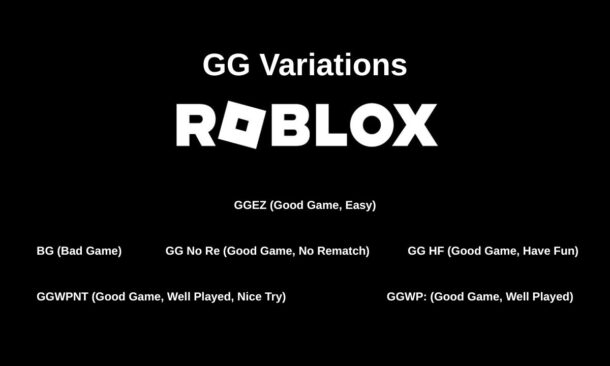
The Roblox community has developed several nuanced variations of “GG”, each carrying its own subtle social meaning:
1. GGWP (Good Game, Well Played)
A more elaborate version that goes beyond basic acknowledgment. “GGWP” specifically highlights the skill and strategic depth demonstrated during the game, offering a more comprehensive form of praise.
2. GGEZ (Good Game, Easy)
A controversial variation that can be perceived as boastful or disrespectful. While some use it playfully, it can come across as dismissive of opponents’ efforts, potentially creating tension within the gaming community.
3. GG No Re (Good Game, No Rematch)
A neutral way of concluding a gaming session, indicating that the player doesn’t wish to continue competing. It provides a clean, straightforward method of ending an interaction.
4. BG (Bad Game)
The antithesis of “GG”, used to express dissatisfaction with a game’s balance, enjoyment level, or perceived fairness. It serves as a critical response to less-than-optimal gaming experiences.
5. GGWPNT (Good Game, Well Played, Nice Try)
A comprehensive variation that acknowledges game quality, player skill, and offers encouragement. It represents a more empathetic approach to post-game communication.
6. GG HF (Good Game, Have Fun)
Often used at a game’s beginning, this variation emphasizes enjoyment and positive anticipation, setting a constructive tone for the upcoming interaction.
Also Read: How To Use Gimkit – A Beginner Guide
Why “GG” Matters
In the Roblox ecosystem, which attracts a predominantly young user base, terms like “GG” play a crucial role in cultivating a healthy online environment. By promoting positive communication, these simple interactions teach valuable lessons about:
- Sportsmanship and fair play
- Mutual respect and empathy
- Constructive communication strategies
- Emotional intelligence in digital spaces
- The importance of positive interactions
Also Read: Game Remake vs. Remaster — Is There a Difference?
Conclusion
To sum it up, “GG” is so much more than a mere acronym, it’s a microcosm of what online gaming should represent. It embodies the core values of enjoyment, trend, community, and respect. For Roblox players, understanding and using “GG” is about more than following a trend; it’s about contributing to a positive, inclusive gaming culture.
Embracing “GG” can significantly enhance your gaming experience whether you’re new to the platform or a seasoned player . It transforms digital interactions from mere competitive exchanges into opportunities for genuine human connection, bridging gaps and creating moments of shared understanding in the vast, creative world of Roblox.




More than half of all kids in the U.S. play Roblox. That staggering reach is exactly what makes Nebraska’s new lawsuit so significant.
Attorney General Mike Hilgers has filed a major legal action against the platform, accusing Roblox of severe and widespread failures to protect children. The allegations aren’t about isolated incidents. They paint a picture of systemic problems baked into Roblox’s operations.
So what exactly is the state claiming, and what does it mean for parents and players? Here’s what you need to know.
What Are the Core Allegations?
Nebraska’s lawsuit lays out a series of severe accusations, arguing that the platform’s design and business practices knowingly expose children to significant harm. The legal action doesn’t target one-off problems; it claims the issues are systemic and deeply embedded in how Roblox runs.
A Platform Designed for Danger?
At the heart of the lawsuit is a bold claim: Roblox’s core features (including direct messaging, private servers, and voice chat) create what officials call a “playground for predators.” These tools allegedly allow direct, unmonitored contact between adults and children, some as young as six.
The scale of communication makes moderation a massive challenge. Roblox processes thousands of messages daily, and the lawsuit argues the company simply hasn’t kept up.
Deceptive Marketing and False Promises
Nebraska’s filing zeroes in on the gap between Roblox’s public image and what’s actually happening on the platform. The company markets itself as safe and kid-friendly, yet the lawsuit alleges it’s been aware of widespread exploitation for years.
A 2024 Hindenburg Research report put it bluntly, describing Roblox as an “X-rated pedophile hellscape.” That’s a far cry from the cheerful, family-oriented branding the company pushes in its advertising.
Systemic Failures Cited
The lawsuit itemizes several specific operational failures that, according to the state, show deliberate choices to prioritize growth over protection:
- – No meaningful age or identity verification: Predators can easily create accounts and pose as children, since the platform doesn’t require real identity checks.
- – Inadequate content moderation: Despite company policies, the sheer volume of user-generated “experiences” includes deeply inappropriate content, with reports citing virtual “strip clubs” and other sexualized environments.
- – Weak parental controls: Many parents say the platform’s safety settings are insufficient or can be easily bypassed by tech-savvy users, including predators.
- – Profit over safety: The lawsuit argues Roblox has knowingly avoided implementing stronger safeguards to maximize user engagement and, ultimately, revenue.
Why Is This Happening Now?
This isn’t a sudden development. It’s the result of years of escalating problems, backed by disturbing internal data and real-world consequences.
A Surge in Exploitation Reports
The most damning evidence comes from Roblox’s own numbers. Child exploitation reports on the platform skyrocketed from 675 in 2019 to over 13,000 in 2023. That’s a nearly 20-fold increase in just four years.
These aren’t abstract figures, either. Since 2018, law enforcement has made at least 30 arrests in cases where predators groomed children on Roblox before abducting or sexually abusing them.
Roblox’s Promises vs. Reality
The lawsuit draws a sharp contrast between the company’s public safety commitments and what’s actually happening behind the scenes. Here’s how those claims stack up against the allegations:
| Roblox’s Public Stance | Allegations in the Lawsuit |
| Claims platform is “built with safety at its core” | Allegedly created an environment exposing children to predators |
| Says it works closely with law enforcement | Failed to implement basic safeguards despite internal exploitation data |
| Promotes parental controls and age-based settings | Controls are insufficient and easily bypassed |
| Markets itself as a “safe, child-friendly space” | Deceptively markets safety while prioritizing profits and engagement |
A Nationwide Legal Backlash
Nebraska isn’t acting alone. Several other states, including Texas, Florida, and Iowa, have filed similar lawsuits. Together, they signal a coordinated, nationwide push for accountability.
This legal pressure reflects a broader shift. States and families are increasingly arguing that the company’s recurring safety issues amount to Roblox platform negligence, an area where specialized law firms are stepping up to advocate for victims.
What This Could Mean for Roblox and Its Users
The outcome of this legal battle could shift the entire digital entertainment industry. The demands go beyond financial penalties; they aim to force fundamental changes to the platform’s operations.
The Future of Safety on Roblox
Nebraska’s lawsuit seeks “injunctive relief,” which could compel Roblox to make major operational changes. Mandatory age and identity verification for all users is one possibility. That would fundamentally alter the platform’s accessibility, but it could drastically improve safety.
There’s clear demand for stronger protections, too. A recent survey found that only 61% of parents feel the current controls are enough. And nearly a third discovered inappropriate content that the controls should’ve blocked.
Steps Parents and Players Can Take Now
While the legal process plays out, families don’t have to wait around. Here are some practical steps you can take right now:
- – Lock down privacy and chat settings: Restrict who can contact your child and join them in experiences.
– Enable and regularly check parental controls: Use the built-in features to set age restrictions and spending limits.
– Talk to your kids about online dangers: Teach them never to share personal information and to be cautious around strangers online. - – Make reporting easy and judgment-free: Make sure your kids know they can come to you about uncomfortable interactions without fear of punishment.
FAQ
Q: Is Roblox safe for my child at all?
A: Millions of children use Roblox without incident, but this lawsuit highlights real risks. Safety depends heavily on enabling the strictest privacy settings, staying involved as a parent, and keeping the conversation open about what happens online.
Q: How does Roblox make money?
A: Roblox is free to play but generates revenue through sales of its virtual currency, “Robux,” which players use to buy in-game items and access certain experiences. The lawsuit alleges this model incentivizes maximizing engagement, sometimes at the expense of safety.
A Wake-Up Call for the Gaming Industry
Nebraska’s lawsuit against Roblox highlights a shift in expectations for platforms used by children. The case raises questions about balancing platform popularity with the duty to protect young users from harm. The outcome could set a new standard for the responsibilities of large-scale multiplayer platforms.
For parents, players, and developers, the takeaway is simple: growth can’t come at the cost of child safety. As legal scrutiny grows and calls for accountability increase, the digital entertainment landscape is primed for change. How companies respond to this case could shape the safety of online spaces for years to come.
We’ve all been there: it’s past midnight, you have school or work in the morning, and you tell yourself, “Just one more level.” Two hours later, you’re still gripped by the screen, your heart racing as you finish a quest or defeat a difficult boss. It isn’t just about the flashy graphics or the catchy music. There is a deep, psychological reason why we find it so hard to put the controller down.
Gaming has become one of the most popular forms of entertainment because it is perfectly designed to satisfy our most basic human needs. While movies allow us to watch a story, games allow us to live it. This sense of participation creates a powerful psychological bond that can improve our mood, boost our confidence, and help us discover who we really are.
Why One More Level is Never Enough
The magic of gaming often comes down to a state that psychologists call “Flow.” This is that feeling of being completely “in the zone.” When you are in a state of flow, the outside world seems to disappear. You aren’t thinking about your chores, your bills, or your social anxieties; you are focused entirely on the task at hand.
Games are experts at creating this feeling because they provide clear goals and instant feedback. In the real world, it can take months of hard work to see progress in a hobby or a career. In a game, you know exactly what you need to do, and you see the results immediately. This clarity allows the brain to relax into a rhythm, making the experience feel both effortless and deeply engaging.
The “Sweet Spot” of Difficulty
One of the biggest reasons games are so captivating is that they are carefully balanced. If a game is too easy, we get bored and turn it off. If it is too hard, we get frustrated and quit. The best games stay right in the middle—the “sweet spot” of difficulty.
As you get better at the game, the game gets harder to match your new skills. This constant challenge keeps us in that state of flow. It pushes us just enough to keep our brains busy without causing a total meltdown. This balance teaches us that we are capable of overcoming obstacles, which is a feeling that many people struggle to find in their daily lives.
Why We Love “Leveling Up”
Humans have a natural desire to feel competent and in control. In our everyday lives, we often feel like we are at the mercy of our bosses, our teachers, or the economy. Games flip the script. They give us a sense of agency—the power to make our own choices and see those choices change the world around us.
The process of “leveling up” is a perfect metaphor for personal growth. Whether you are gaining experience points to unlock a new ability or finding a stronger piece of armor, you are seeing a tangible version of your own progress. This constant sense of achievement is a major part of why people seek out resources like this to understand how digital achievements can mirror real-world personal development. When we succeed in a game, our brain registers it as a real success, which can give our self-esteem a much-needed boost.
How Games Rewire Our Mood
The thrill of gaming is powered by dopamine, the brain’s “reward” chemical. Every time you find a hidden treasure, beat a boss, or clear a difficult platforming section, your brain gives you a tiny hit of dopamine. This creates a “reward loop” that makes us want to keep playing to get that next feeling of success.
However, games also change how we handle failure. In real life, failing can feel embarrassing or permanent. In a game, failure is just a part of the learning process. We have the “Respawn”—the chance to try again immediately. This creates a safe environment to take risks. We learn that failure isn’t the end; it’s just a signal that we need to try a different strategy. This resilience is a psychological skill that can actually help us become braver in the real world.
Finding Your Digital Tribe
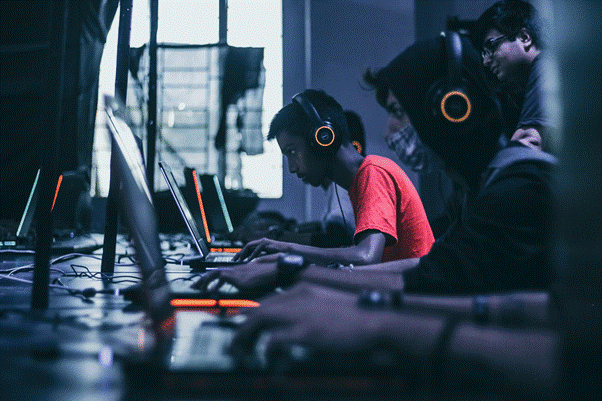
Even though many people think of gaming as a lonely activity, it is actually one of the most social things we can do. Multiplayer games allow us to find our “digital tribe.” For many, these virtual spaces are where they find their most supportive communities.
Working together to win a match or complete a raid builds deep bonds of teamwork and trust. Furthermore, the use of an avatar allows us to experiment with our identity. We can be a brave warrior, a clever strategist, or a helpful healer. This allows us to explore different sides of our personality that we might be too shy to show in person. By trying on these different roles, we often discover strengths we didn’t know we had.
It’s More Than a Distraction
Gaming is often dismissed as “wasted time,” but the psychology behind it tells a different story. It is a way for us to practice being persistent, to feel a sense of mastery, and to connect with others in a meaningful way. It provides a safe space to decompress from the stresses of modern life and to remember what it feels like to be the hero of our own story.
The captivating nature of gaming isn’t a trick; it’s a fulfillment of our deep-seated need to grow and belong. When we take the persistence and curiosity we find at the console and apply it to our non-digital lives, we realize that the lessons we learned while “leveling up” were real all along. Next time you pick up a controller, remember: you aren’t just playing a game—you are giving your brain a chance to shine.
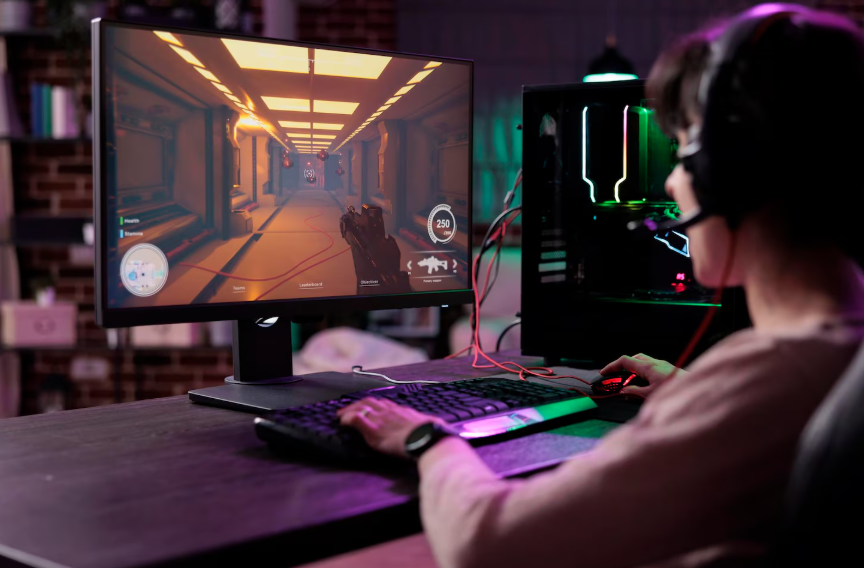
Addiction recovery isn’t a straight line and treatment and healthy routines that keep people on track can come in many different forms. Particularly, when it comes to the newfound time that was once spent drinking or taking drugs.
While traditional approaches such as counselling and support from addiction and alcohol rehabilitation centres remain key to any help with addiction, there is also a growing recognition that healthy hobbies can also play a valuable role.
Interestingly, that can also include gaming when approached mindfully and in moderation. It can provide surprising benefits during recovery and a real sense of progress. And here’s exactly why…
It Provides Structure and Routine
Early recovery can leave large stretches of unstructured time. Hours that were once spent drinking or using substances suddenly feel empty, which can increase cravings and restlessness.
Gaming can introduce a sense of routine. Whether it’s logging in for an hour in the evening or completing a daily challenge, it creates a predictable activity to look forward to. Many games reward consistency, offering incremental progress that mirrors the steady effort required in recovery.
This structure can be particularly helpful during vulnerable times of day, such as evenings or weekends, when triggers might be strongest.
It Offers a Healthy Dopamine Boost
Addictive substances often hijack the brain’s reward system, creating intense spikes of dopamine. In recovery, people can experience a temporary “dopamine deficit”, leading to low motivation or reduced pleasure in everyday activities.
Gaming provides achievable goals, clear feedback and a sense of accomplishment, all of which stimulate dopamine in a more balanced way. Completing a level, solving a puzzle or mastering a new skill can produce a genuine sense of satisfaction.
While it’s important not to replace one compulsive behaviour with another, moderate gaming can serve as a bridge while the brain recalibrates and natural rewards become enjoyable again.
It Encourages Problem-Solving and Focus
Many games require strategic thinking, planning and concentration. Engaging in these cognitive processes can help sharpen focus and improve mental resilience, areas that may have been affected by prolonged substance use.
Puzzle games, role-playing games and even certain action titles demand decision-making under pressure, adaptability and persistence. These are skills that translate well into recovery, where managing triggers and setbacks often requires calm, deliberate thinking.
Gaming can also act as a form of mindfulness. When fully immersed in a task, intrusive thoughts and cravings may temporarily subside, giving the mind space to reset.
It Facilitates Social Connection
Isolation is a common challenge in addiction. Recovery frequently involves distancing oneself from social circles linked to substance use, which can initially feel lonely.
Online multiplayer games, co-operative missions or gaming communities can provide a sense of belonging. Shared objectives and teamwork foster communication and camaraderie without the pressure of alcohol-centred environments.
For some individuals, gaming offers a low-stakes way to rebuild social confidence. Speaking through a headset or participating in online forums can feel less intimidating than face-to-face interaction, particularly in the early stages of recovery.
That said, balance remains key. Gaming should complement, not replace, real-world support networks and meaningful relationships.
It Creates a Sense of Progress and Achievement
Recovery is built on small, consistent wins. Gaming mirrors this principle through levelling systems, unlocked achievements and visible progress bars.
Seeing tangible evidence of advancement, even in a virtual world, can reinforce the idea that effort leads to reward. This mindset can strengthen perseverance in recovery, where progress may sometimes feel slow or intangible.
Moreover, gaming can remind individuals that enjoyment and excitement are still possible without substances. Rediscovering fun is an essential part of building a fulfilling sober life.
-
 Guides6 years ago
6 Proven Ways to Get more Instagram Likes on your Business Account
-
Mainstream11 years ago
BioWare: Mass Effect 4 to Benefit From Dropping Last-Gen, Will Not Share Template With Dragon Age: Inquisition
-
 Mainstream7 years ago
How to Buy Property & Safe Houses in GTA 5 (Grand Theft Auto 5)
-

 Guides2 years ago
Free Fire vs PUBG: Comparing Graphics, Gameplay, and More
-

 Guides1 year ago
50+ Free Fire ID and Passwords Login List (Giveaway) 2025
-
 Casual2 years ago
8 Ways to Fix Over-Extrusion and Under-Extrusion in 3D Printing
-

 Other2 years ago
Ajjubhai UID: Free Fire Details & Earnings
-
 Mainstream13 years ago
Guild Wars 2: The eSports Dream and the sPvP Tragedy