
iGaming
Social Casinos Explained: What They Are, How They Work, and Why Millions of Players Love Them

If you’ve ever browsed the App Store or Google Play looking for casual games, chances are you’ve come across apps that look exactly like online casinos: slot machines with flashing reels, poker tables filled with players, roulette wheels spinning under bright lights.
At first glance, they might appear indistinguishable from real-money gambling platforms. Yet many of these apps belong to a rapidly growing category known as social casinos.
Social casinos recreate the experience of traditional casino games but remove one crucial element: real-money wagering. Instead of betting cash, players use virtual chips to spin slot reels, play poker hands, or participate in tournaments against other players.
What might seem like a simple niche within mobile gaming has actually grown into one of the most lucrative segments of the industry, generating billions of dollars every year and attracting millions of players across the globe.
So what exactly are social casinos, how do they work, and why have they become so popular? Let’s take a closer look.
What Is a Social Casino?
At its most basic level, a social casino is a gaming platform that offers casino-style games purely for entertainment rather than for real-money gambling.
Players receive virtual currency, usually referred to as chips, coins, credits, or tokens, which they use to place bets within games such as slots, blackjack, roulette, poker, and bingo. These virtual chips have no real-world monetary value, meaning players cannot convert their winnings into cash or withdraw them from the platform.
This distinction is what separates social casinos from traditional online casinos. In a real-money casino environment, players deposit actual money, place wagers, and have the possibility of withdrawing winnings. In a social casino, however, the experience revolves entirely around virtual gameplay where chips circulate only within the game itself.
Because of this key difference, social casinos are generally treated as video games rather than gambling platforms in many jurisdictions around the world. For players, the result is an experience that captures the excitement and visual appeal of casino games while focusing primarily on entertainment, competition, and progression instead of financial stakes.
Where You’ll Find Social Casinos
Social casino games can be found across multiple platforms, although mobile devices have become their natural home.
Today, most players encounter these games through mobile apps available on iOS and Android devices. The mobile format suits them perfectly, allowing players to spin slot reels during short breaks or participate in tournaments whenever they have a few minutes to spare.
Social casinos also exist in browser-based formats, where players can access games directly through desktop websites without downloading any applications. In addition, many social casino titles have historically thrived on social networks such as Facebook, where players could invite friends, share rewards, and compete in multiplayer games.
In fact, the social casino boom initially took off in the early 2010s thanks to Facebook gaming, when poker and slot apps began spreading rapidly through friend invitations and viral social mechanics. Although the ecosystem has expanded significantly since then, smartphones now account for the vast majority of social casino gameplay worldwide.
The Games You’ll Find in Social Casinos
Step inside almost any social casino platform and the games will immediately feel familiar. Developers intentionally design these titles to resemble traditional casino games as closely as possible.
Slot machines dominate the category by a wide margin. Industry estimates suggest that slot games alone account for between sixty and eighty percent of total social casino revenue. These games come in a wide variety of styles, ranging from classic fruit machines reminiscent of land-based casinos to elaborate video slots featuring animated themes and cinematic visuals.
Players will encounter familiar gameplay mechanics such as free spins, wild symbols, multipliers, bonus rounds, and jackpot-style rewards. From a design standpoint, these slots often look and behave almost identically to those found in real online casinos.
Beyond slots, social casino platforms frequently include a variety of classic table games. Blackjack tables allow players to test their strategy against the dealer, while roulette wheels provide the familiar thrill of watching the ball land on a numbered pocket. Baccarat and craps are also commonly available, often presented with multiple variations to accommodate both beginners and experienced players.
Poker has long played a central role in the social casino ecosystem. Texas Hold’em tables are particularly widespread, allowing players to compete against others from around the world. Many poker apps also feature tournaments, ranking systems, seasonal competitions, and achievement structures that reward consistent play.
Some social casinos extend the experience even further by offering bingo rooms and keno draws. These games are often designed with bright visuals and themed environments that encourage players to interact with each other while waiting for numbers to be drawn.
Virtual Chips: The Currency of Social Casinos
Unlike traditional casinos where real money is the central currency, social casinos revolve around virtual chips. When players first download a social casino app or register on a website, they typically receive a free starter package of chips. These chips function as the in-game currency used to place bets, spin slot reels, or participate in table games.
As players continue playing, they can accumulate more chips in several ways. Winning games naturally increases their chip balance, while daily login bonuses provide regular rewards simply for returning to the platform. Special promotional events, tournaments, and limited-time bonuses also distribute additional chips to active players.
Eventually, however, players may run out of chips. When this happens, they usually face a simple choice: they can wait for the next free reward or purchase additional chips through in-app purchases. This system is the foundation of the social casino economy.
How Social Casinos Make Money
At first glance, it might seem puzzling that an industry where players cannot win real money can still generate billions in annual revenue. The answer lies in microtransactions and player engagement.
Most social casino platforms offer virtual currency packages through their in-app stores. These packages typically vary in size and price, allowing players to choose how many chips they want to purchase. Small bundles of chips might cost less than a dollar, while larger packages can cost twenty dollars or more.
Although a large percentage of players never spend money at all, the overall player base is enormous. Within this audience, a small segment of highly engaged players contributes a disproportionate share of revenue. These players, often referred to in the gaming industry as “whales”, may spend significant amounts of money on virtual currency in order to keep playing without interruption.
When millions of players participate in these systems worldwide, even relatively small purchases can generate remarkable revenue.
The Social Features That Make These Games So Engaging
The “social” aspect of social casinos is more than just a label. Interaction between players is a central component of the experience.
Many platforms include global leaderboards where players compete for top rankings based on their winnings or activity. Seasonal tournaments allow players to climb competitive ladders and earn rewards, while friend invitation systems encourage users to bring others into the game.
Some platforms also allow players to send virtual chips to friends or communicate through in-game chat features. These systems create a sense of community that transforms casino-style gameplay into something closer to a shared multiplayer experience.
Instead of simply spinning slot reels alone, players might find themselves competing with friends for leaderboard positions or participating in limited-time tournaments that reward the most active participants.
The Psychology Behind Social Casino Games
Part of the success of social casinos lies in their clever use of psychological game design principles. Many of these games rely on variable reward systems, a mechanism where wins occur unpredictably. This unpredictability creates excitement and anticipation, encouraging players to continue playing in the hope of landing the next big win.
Progression systems also play a major role. Players often unlock new levels, achievements, or VIP tiers as they spend more time in the game. This sense of advancement adds long-term goals beyond the individual outcomes of each spin or hand.
Daily rewards further reinforce engagement by encouraging players to return regularly. Simply logging into the game each day may provide free chips or bonus items, creating a habit-forming loop. Limited-time events and special promotions introduce an additional sense of urgency, motivating players to participate before rewards disappear.
These mechanics are widely used throughout mobile gaming, but when combined with casino-style gameplay they create especially strong engagement cycles.
The Size of the Social Casino Industry
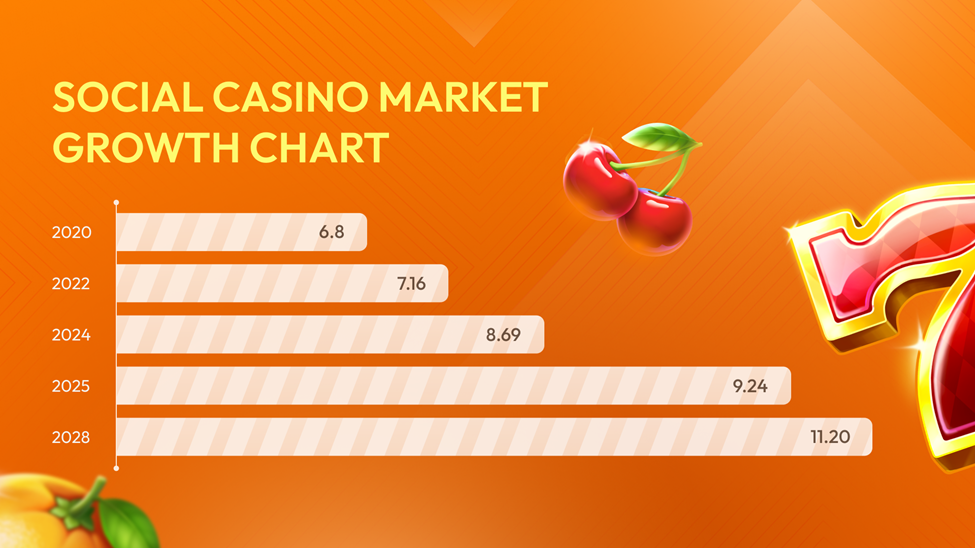
Despite their casual appearance, social casinos represent one of the most financially successful segments of the mobile gaming industry. Global revenue estimates suggest the market generates between seven and eight billion dollars annually, placing it among the most profitable gaming categories worldwide.
The largest markets include the United States, Japan, South Korea, Germany, and the United Kingdom. The United States alone accounts for a substantial portion of total revenue, supported by millions of active players across dozens of popular apps.
How Social Casinos Connect to Real-Money Gambling
Although social casinos themselves do not involve real money wagering, they still occupy an interesting position within the wider gambling ecosystem. For many players, social casinos serve as an entry point into casino-style games. Someone who first discovers slot machines through a mobile app may later develop an interest in real-money casinos.
At the same time, many developers design their games so they can exist in both environments. The difference between a real-money slot and a social casino slot often lies primarily in the currency system, payout mechanics, and regulatory compliance requirements.
Legal Debates Around Social Casinos
Even though social casinos are usually categorized as games rather than gambling platforms, the industry has occasionally attracted legal scrutiny. Critics sometimes argue that the purchase of virtual chips resembles gambling behavior, particularly when players spend large sums on in-game currency. Several lawsuits in the United States have explored whether social casino games should be considered gambling products under certain state laws.
The results of these cases have varied depending on jurisdiction, and the legal environment surrounding social casinos continues to evolve as regulators examine the rapidly growing sector.
The Rise of Sweepstakes Casinos
In recent years, a hybrid model has emerged that blends social casino gameplay with prize-based reward systems. These platforms are commonly known as sweepstakes casinos. Instead of relying on a single type of virtual currency, they typically use two different currencies. One is used for standard play-for-fun games, while the other may allow players to redeem prizes under sweepstakes rules.
This structure allows certain operators to offer prize opportunities while remaining within specific legal frameworks in some regions. As a result, sweepstakes casinos have experienced rapid growth and increasing popularity in recent years.
The Future of Social Casinos
As mobile gaming continues to evolve, social casinos are likely to evolve alongside it. Developers are already experimenting with richer storytelling elements, turning slot machines into themed adventures with characters and narratives. Cross-platform systems are allowing players to move seamlessly between mobile apps and web platforms using the same accounts.
Live multiplayer events, seasonal tournaments, and hybrid gameplay mechanics that blend casino elements with puzzle or role-playing systems are also becoming more common. At the same time, increased attention from regulators and consumer protection groups may influence how social casinos operate in the future.
iGaming
What Makes a Casual Game Easy to Pick Up? A Mechanics-First Guide
What Makes a Casual Game Easy to Pick Up? A Mechanics-First Guide


A game can have lovely artwork, a clever idea and plenty of content, yet still feel oddly difficult to begin. You open it, face a wall of icons or a lengthy explanation, and suddenly the spare ten minutes you had set aside doesn’t feel quite enough.
That’s why low-friction discovery matters. Approachable casual games don’t demand that you study a manual before you can enjoy the first round. They give you something understandable to do, show you what happened when you did it, then let you decide whether you’d like another go.
It sounds simple, but it’s a thoughtful bit of design. Whether you prefer a word puzzle, a match-style game, a card game or a number-based format, the mechanics determine whether the experience feels welcoming or like hard work.
The first few minutes do most of the talking
A casual game is easy to pick up when its opening moments answer three questions without making you hunt for the answers:
- What am I trying to do?
- How do I do it?
- How will I know whether it worked?
The strongest introductions let you learn by playing. Rather than presenting several screens of instructions, they offer one small action. Tap, place, match, choose or mark something. You receive an immediate response, and the next step becomes clearer.
I find this is the difference between a game that feels inviting and one that sits untouched on a phone for months. You don’t need every detail at once. You just need enough confidence to start.
Onboarding should be helpful, not a hurdle
Good onboarding is often almost invisible. A highlighted button, a brief prompt or a practice round may be all that’s needed. The aim isn’t to explain every possible feature. It’s to introduce the core loop, meaning the action you repeat during play.
For instance, a straightforward puzzle loop might be:
- Look at the board
- Make one move
- See the result
- Adjust your next move
That rhythm is easy to understand because every action has a visible consequence. The same principle works in many formats. If you’re marking called numbers, building a sequence, sorting tiles or selecting answers, the game should make the immediate task obvious.
Too much instruction can be as off-putting as too little. When a game pauses after every tap to explain another button, it breaks the flow. A better approach is to reveal features when they become relevant.
Rules should be readable at a glance
Readable rules don’t always mean very few rules. Some games have surprising depth, but their basic logic is clear enough that you can form a sensible first plan.
Look for games where:
- The main objective is visible on the screen
- Key symbols are consistent throughout
- Your available actions are easy to spot
- A mistake is understandable rather than mysterious
- Help is available without forcing you out of the round
Visual hierarchy matters here. The most important information should be larger, clearer or placed where your eye naturally goes first. If score, time, goals and menus are all shouting at the same volume, it becomes tiring.
Plain language helps too. “Match three colours” is kinder than a menu full of unexplained terms. There’s nothing wrong with specialist language later on, once you’ve found your feet.
Early feedback makes learning feel natural
Feedback is the game’s way of responding to you. It might be a tile changing colour, a short sound, a progress bar moving, or a clear message showing why a move can’t be made.
The useful kind is prompt and specific. If you complete a pattern, you should know it immediately. If an option is unavailable, the game should indicate why. Ambiguous feedback leaves players guessing, and guessing about the controls is rarely enjoyable.
Early progress matters, too. That doesn’t mean every first attempt should be effortless. It means the game gives you a fair chance to understand its rhythm before asking for more careful decisions.
A well-designed opening says, “You’ve got this.” Not through empty praise, but by making the cause and effect of play easy to follow.
Comparing mechanics: the details that affect accessibility
Once the basics are clear, a few practical mechanics decide whether a game fits neatly into your routine. The right choice depends less on what’s fashionable and more on how you actually like to spend your downtime.
Session length: can it fit the time you have?
Some games work beautifully in a five-minute gap. Others need a longer, uninterrupted sitting before they make sense. Neither is better, but it’s worth knowing which you’re choosing.
Short-session games tend to have:
- Self-contained rounds
- Quick restarts
- Little penalty for stopping after one go
- A clear end point
Longer formats may suit you if you enjoy settling into a puzzle or learning a more involved system. The key is honesty. A game that claims to be casual but takes twenty minutes before you can pause may not be the relaxed option you expected.
Before committing, try one full round and notice whether it ends naturally. If it does, you’re more likely to return to it on your own terms.
Progression: satisfying or demanding?
Progression gives a sense of movement over time. You might unlock new levels, encounter fresh layouts, collect cosmetic items or gain access to different modes. In moderation, it adds variety.
The trouble starts when progress becomes a barrier to the enjoyable bits. If you have to complete many repetitive tasks before trying a mode that interests you, the game is putting its structure ahead of your time.
An approachable game generally lets you sample its main idea early. It may have optional goals for people who want them, but it doesn’t make every player follow the same lengthy route.
Ask yourself a simple question: am I continuing because I’m interested in the next round, or because I feel obliged to tick off a task list? Your answer tells you a lot.
Optional community features
Social features can make a familiar format feel warmer. A shared room, a friendly leaderboard or the chance to play alongside others may give a game more atmosphere.
But accessibility means having choices. Not everyone wants to chat, join a group or react to every event. A good social system lets you participate quietly, adjust notifications and understand who can see what.
Adults should be able to review chat, privacy and notification settings, and use the service without joining community features.
The best communities make room for different styles of participation. You can say hello if you fancy it, or simply focus on the game.
Interface clarity: fewer surprises, more confidence
A clear interface is more than a tidy screen. It means important controls behave consistently, labels make sense and you can recover from an accidental tap without panic.
On a smaller screen, this becomes even more important. Buttons need enough space around them, text must remain readable, and pop-ups shouldn’t cover the information you need.
A quick test is to close the game and return later. Can you tell where you are and what to do next within a few seconds? If yes, the interface is doing its job.
Cross-platform access: continuity counts
Many people switch between a phone, tablet and computer depending on where they are. A game that works well across devices can feel far easier to keep up with, provided the experience is consistent.
Look for sensible touches such as:
- Progress that carries across devices where supported
- Controls designed for touch and mouse use
- Readable layouts at different screen sizes
- Easy account and privacy settings
- Clear information about data use
Cross-platform access isn’t just about convenience. It lets you choose the screen that best suits the moment, rather than wrestling with tiny controls when you’d rather use a larger display.
## UK bingo resources (18+)
>
Bingo is a useful example of how familiar mechanics can reduce the learning curve. Adults comparing new bingo sites on Jackpotjoy may wish to assess which formats are available, how clearly rooms and cards are presented, how the service works on mobile, and what safer-gambling tools are offered.
>
Jackpotjoy is a contextual destination for readers interested in exploring 75-, 80- and 90-ball bingo formats. Take time to read the room information and controls before choosing to participate.
A practical checklist before you settle on a game
You don’t need to make game discovery a research project. A few small checks can save a lot of time and prevent that feeling of being locked into something that doesn’t suit you.
Choose the smallest possible first step
Start with a single round, a demo where available, or a free introductory section. Don’t judge a game only by its store description or screenshots. The real test is how it feels in your hands.
Consider these questions:
- Can I understand the main objective in a minute or two?
- Is there a natural stopping point?
- Do the controls feel comfortable on my preferred device?
- Can I turn off sound, notifications or chat if I want to?
- Is the next step clear without constant prompts?
If the answer is mostly yes, it’s probably a good candidate for your regular rotation.
Keep time and spending boundaries clear
For any game with optional purchases or paid participation, decide your boundaries before you begin. It’s much easier to make a calm decision at the start than in the middle of a session.
You might choose a time limit, switch off non-essential notifications, or use device-level controls to keep your play separate from the rest of your day. Check the settings menu early. The presence of clear controls is often a good sign that a platform respects the player’s choices.
When gambling is involved, use licensed operators and look for practical tools such as deposit limits, time reminders, breaks and self-exclusion options. The Gambling Commission’s safer gambling information is a useful starting point for UK adults.
Bingo room information for adults
For adults exploring online bingo, format has a real effect on how easy a room feels to follow. The basic idea is straightforward: numbers are called at random and players mark matching numbers on their cards, with the required winning pattern shown in the game information. As the background to bingo explains), variations use different card layouts and number ranges.
75-ball bingo
This format uses numbers from 1 to 75 and is commonly associated with a five-by-five card. It often features named patterns, so it can be helpful for people who like a visible target. Before joining a room, check the pattern required for that round, as it may be a line, a shape or a full-card objective.
80-ball bingo
Eighty-ball games generally use a four-by-four card. The layout can feel neatly compact on a mobile screen, though the room display still matters. Look for a clear indication of called numbers, your marked positions and the current game stage.
90-ball bingo
The traditional UK-style 90-ball card is arranged in three rows and nine columns. Rounds often progress through distinct stages, such as one line, two lines and a full house. That structure can be reassuring because you can see the immediate objective, although new players may want to begin with one card and get comfortable with the display first.
Whichever format you look at, room choice matters. A beginner-friendly room should present its rules, card layout and controls plainly. On mobile, make sure numbers are legible, automatic marking settings are explained, and it’s easy to access account limits or take a break.
The mechanics that make casual games approachable are rarely flashy. They’re the quiet details: a goal you can see, controls you can trust, feedback that makes sense and the freedom to stop when you’ve had enough. Find those things, and trying something new feels far less like a commitment.
Bingo is chance-based entertainment, so readers should set limits and use available responsible-gambling controls.
Casino
Farms, Cafés and Cats: Why Cozy Games Are Quietly Taking Over the Gaming World
Farming sims, puzzle games and relaxing adventures are booming. Discover why “cozy gaming” became one of the biggest trends and what it says about how we.

For decades, the loudest games got the most attention. Explosions, headshots, boss battles and competitive rankings dominated the conversation. Then something unexpected happened. Millions of players started choosing games about watering crops, decorating tiny houses, running cafés and befriending talking animals. “Cozy gaming” went from a niche label to one of the most talked-about movements in the industry. Why are so many people choosing calm over chaos?
What Makes a Game “Cozy”?
There is no official definition, but cozy games usually share a few ingredients:
- Low pressure: no timers screaming at you, no permanent failure
- Gentle goals: grow, build, collect, decorate, befriend
- Warm visuals: soft colours, hand-drawn art, lots of little details
- Comforting sound: acoustic music, rain on windows, birdsong
- Player freedom: you decide the pace
The feeling matters more than the genre. A farming sim, a puzzle game or a fishing adventure can all be cozy if they leave you calmer than when you started.
Why Now?
Several trends collided at once. Busy, stressful lives made people crave digital spaces that feel safe. Remote work and long evenings at home created time for slower hobbies. And a new generation of players, many of whom never related to hyper-competitive shooters, found games that matched their tastes.
Gaming itself has also broadened. Today, “gaming” covers everything from console blockbusters to mobile puzzles, streaming, esports and online entertainment. Brands such as Casino Zoome are part of that wider digital entertainment landscape too, which is exactly why it is worth thinking about what kind of play actually makes you feel good, and setting limits on the kinds that don’t.
The Psychology of Calm Play
Cozy games tap into some deeply satisfying feelings.
Visible Progress
Watching a garden grow or a shop fill with customers gives a sense of steady achievement. Unlike real life, effort in cozy games is almost always rewarded.
Control
In a world full of uncertainty, arranging furniture exactly how you like it can be surprisingly soothing.
Routine
Many cozy games follow daily cycles: wake up, water crops, visit the village, go to bed. That rhythm becomes a small, comforting ritual.
Kindness
Characters are friendly, conflicts are small and helping others is often the main goal. It is a refreshing change from games built around defeating opponents.
Cozy Doesn’t Mean Easy
Some players assume cozy games are only for beginners. Not true. Many include complex crafting systems, deep economies, tricky puzzles and hundreds of hours of content. The difference is that difficulty is optional. You can optimise every inch of your farm or simply enjoy the sunset.
The Community Factor
Cozy gaming has created warm online communities. Players share screenshots of their homes, swap design ideas, trade in-game items and celebrate each other’s creations. Streamers who play cozy games often attract relaxed, supportive audiences, a contrast to the heated atmosphere around some competitive titles.
Cozy Gaming and Wellbeing
Many players describe cozy games as a way to unwind after work or to manage stressful periods. Short sessions before bed, a gentle puzzle with morning coffee or a weekend farming marathon can be genuinely restorative.
That said, any hobby can take over if it is not balanced. Even the calmest game can eat into sleep if “just one more day” turns into three hours. The same advice applies to every kind of screen time: notice how you feel afterwards, and set boundaries that protect sleep, work and relationships.
Popular Types of Cozy Games
- Farming and life sims: grow crops, raise animals, build relationships
- Decorating games: design rooms, houses and whole towns
- Café and shop management: serve customers at your own pace
- Gentle puzzle games: relaxing logic without time pressure
- Exploration games: wander beautiful worlds with no enemies
- Creature collectors: befriend rather than battle
How to Find Your Next Cozy Game
- Look for “relaxing” or “wholesome” tags in game stores.
- Watch a few minutes of gameplay to check the pace.
- Read community reviews focusing on mood, not just mechanics.
- Try demos where available.
- Choose by feeling: what do you want to feel after playing?
The Industry Is Listening
Big studios have noticed the trend. Cozy elements such as home building, farming and gentle side activities now appear in many mainstream games. Independent developers, meanwhile, continue to lead the way with small, heartfelt projects.
The Bottom Line
Cozy games prove that gaming doesn’t have to be loud to be powerful. They offer calm, creativity and connection in a busy world. Whether you play five minutes a day or lose entire weekends in a virtual village, the best gaming habits are the ones that leave you feeling better, not worse.

Witcher has already had a long and successful run with fans. Dedicated followers of the franchise know that the first novel in Andrzej Sapkowski’s Witcher series was released in 1986, many moons before Dough Cockle lent his voice to the titular character (and permanently replaced whatever we’d had in mind before that point) in CD Projekt’s video game, and a great many moons before Henry Cavill stepped into the role for the highly-acclaimed first season of the Netflix original series.
Floundering with Fans, or Ready for More?
The Netflix series brought new interest to Rivia and its gruff, maybe-human-but-maybe not protagonist, Geralt – AKA, ‘Witcher’. But, true to most Netflix originals, that interest proved to be relatively fleeting. Netflix’s own 2023 What We Watched: A Netflix Engagement Report showed a gradual decline as the seasons progressed. While first came in at 171st in the platform’s most-watched list of shows, the second and third seasons ranked 233rd and 556th respectively. Much of this can simply be attributed to the fickle nature of pop culture, and for the controversial decision to replace Henry Cavill with Liam Hemsworth. Not only was Cavill’s portrayal of Geralt widely praised as being strikingly accurate to the original game design (the place where, arguably, most fans first encountered him), but he is also a self-proclaimed video games nerd who had already spent many hundreds of hours playing the CD Projekt games.
While Hemsworth’ s own portrayal of Geralt was admirable given the circumstances under which he was introduced to the project, one thing seems for certain: there is still plenty of scope left for fan engagement with this franchise.
After all, avid players of the Witcher games are among the most committed of any fanbase. While this comes at a time when game developers are facing mounting criticism for ‘playing it safe’ and clinging too hard to tried-and-tested franchises, it’s also true that winning formulas can continue to dominate, provided developers play their cards right. Final Fantasy has somewhere in the region of 80 games to its name, while EA’s FIFA has 30 main installment titles and a devoted following. Similarly, Big Bass is a popular franchise among online casino Canada platforms, with no less than 39 iterations to its name – and no sign of slowing down any time soon.
What We Know
In August this year, CD Projekt announced that their hugely popular iteration in the series, Witcher 3, would be receiving a major DLC in late September. This was a highly unusual move. The original game was released way back in 2015. For a developer to release such a major update free of charge more than a decade on from its launch is unprecedented.
Furthermore, the developer announced the upcoming 2027 release of Witcher 4 – a highly anticipated title that has eclipsed the studio for more than four years.
Finally, after the release of Witcher 4 next year, fans have the release of a remade Witcher 1 to look forward to, which promises to rework much of the game to make it more playable for modern audiences.
There are rumours circulating that the Witcher 4 intends to transform combat mechanics, and that the newest DLC for Witcher 3 will represent something of a sandbox for developers to see how it goes down with fans. If true, this could well hint at plans for plenty more future releases within the franchise down the line. We just need to hope that the combat is worth the wait.
-
 Guides7 years ago
6 Proven Ways to Get more Instagram Likes on your Business Account
-
Mainstream12 years ago
BioWare: Mass Effect 4 to Benefit From Dropping Last-Gen, Will Not Share Template With Dragon Age: Inquisition
-
 Mainstream8 years ago
How to Buy Property & Safe Houses in GTA 5 (Grand Theft Auto 5)
-

 Guides2 years ago
Free Fire vs PUBG: Comparing Graphics, Gameplay, and More
-

 Guides2 years ago
50+ Free Fire ID and Passwords Login List (Giveaway) 2025
-
 Casual3 years ago
8 Ways to Fix Over-Extrusion and Under-Extrusion in 3D Printing
-

 Other2 years ago
Ajjubhai UID: Free Fire Details & Earnings
-

 Features2 years ago
Exploring Valorant eSports Stats: Unveiling the Metrics Behind Competitive Excellence